Basement Waterproofing NJ Mistakes Homeowners Should Avoid

A wet basement rarely starts as a dramatic flood. More often, it begins with a faint musty smell after heavy rain, a thin chalky line on the wall, or a small puddle that shows up in the same corner every spring. Many New Jersey homeowners live with those early signs far longer than they should. They mop the floor, run a dehumidifier, and hope the problem stays manageable.
That approach usually gets expensive.
Basement water problems in New Jersey tend to be persistent because the conditions that cause them are persistent. Older housing stock, seasonal freeze and thaw cycles, clay heavy soils in some areas, high water tables in others, and dense development that limits drainage all create pressure around foundation walls. When homeowners make the wrong fix, or choose the wrong contractor, the water almost always comes back.
I have seen people spend thousands on cosmetic repairs before dealing with the actual source of moisture. I have also seen homeowners panic after one storm, buy a quick fix from a big box store, and end up trapping more water inside the wall assembly. Basement waterproofing is one of those areas where a bad decision can look fine for a month and fail badly within a year.
If you are researching Basement Waterproofing NJ services, it helps to know not just what works, but what routinely goes wrong.
Treating stains and odors like the problem instead of the symptom
This is probably the most common mistake. A homeowner notices peeling paint, white powder on the walls, a musty smell, or minor mold on stored cardboard boxes. The first instinct is to clean, repaint, and deodorize. That makes sense on the surface, but those signs are evidence, not root causes.
White powder on masonry, often called efflorescence, forms when water moves through concrete or block and leaves mineral deposits behind. Paint that bubbles or flakes off basement walls usually fails because moisture is pushing from the exterior side inward. A musty odor often means the air has been damp for a long time, even if liquid water is not visibly pooling.
One family I spoke with in northern New Jersey repainted the lower half of their finished basement twice in three years. Each time the paint looked better for a season, then started to blister again. The wall itself was not the real issue. Poor grading outside and a short downspout were channeling roof runoff directly next to the foundation. The wall kept getting wet because the water source was never addressed.
When symptoms are treated in isolation, the basement may look cleaner for a while, but the structure remains under moisture stress. Over time that can damage framing, insulation, flooring, and air quality.
Assuming every wet basement needs the same solution
There is no universal waterproofing fix. That is another costly mistake. Homeowners often hear one recommendation from a neighbor or online forum and assume it applies to every basement: install a sump pump, coat the walls, excavate outside, run a dehumidifier, or add a French drain. Any of those can be useful, but only in the right context.
A basement can take on moisture in several different ways. Surface water may be draining toward the house. Groundwater may be rising under the slab. Hydrostatic pressure may be forcing water through cove joints where the wall meets the floor. A cracked foundation wall may be allowing seepage through a narrow path. Window wells may be filling during storms. Humid summer air may be condensing on cool surfaces, creating what looks like leakage but is actually a ventilation and humidity problem.
Those are different problems. They do not deserve the same cure.
A proper diagnosis usually starts outside, not inside. Contractors and homeowners alike make errors when they focus only on the interior stains without studying grading, gutters, downspouts, soil settlement, hardscape slope, and nearby water discharge. In New Jersey neighborhoods with tight lot lines, one neighbor’s drainage changes can also affect the next property downhill. That detail gets missed more often than you might think.
Relying on waterproof paint as a standalone fix
Waterproof coatings have a place, but they are frequently oversold. The can promises a sealed wall and a dry basement. For minor vapor transmission, some products help. For actual water intrusion, they are often little more than a temporary mask.
Here is the issue. If liquid water is moving through a wall under pressure, a coating on the interior side is fighting from the wrong direction. It may slow visible seepage for a period, but it does not remove the water load outside. Eventually the bond fails, the coating blisters, or the water simply finds another path.
This becomes even riskier in older block foundations. Concrete block walls can hold and channel water inside their hollow cores. A surface coating may hide signs for a while, but the wall system is still wet. That can complicate future repairs because it obscures where the moisture is actually traveling.
Homeowners are not wrong to want a simple fix. The problem is that simple and effective are not the same thing. If you are seeing active leaks, recurring dampness, or floor edge seepage, a coating alone is rarely the answer.
Ignoring the outside drainage picture
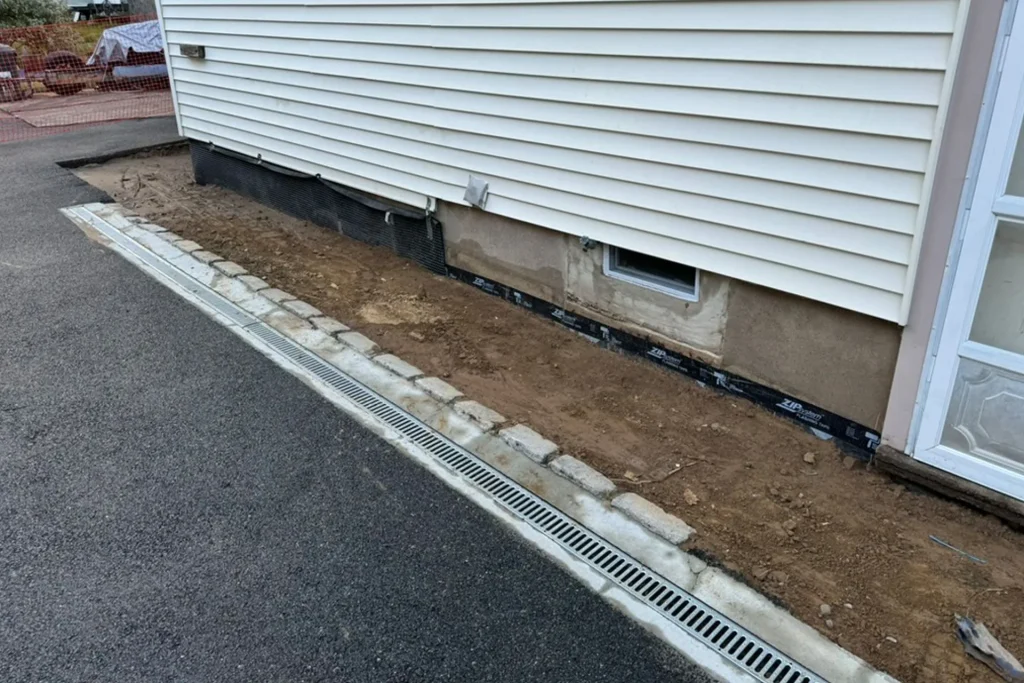
Some of the most successful basement waterproofing projects are not glamorous at all. They start with gutters, downspout extensions, grading corrections, and surface drainage improvements. That is not exciting work, which is probably why many homeowners skip it and jump straight to interior systems.
Yet roof runoff is a major contributor to basement moisture. A modest storm can dump hundreds of gallons of water from a roof in a very short time. If that water lands right next to the foundation, it soaks the soil, raises pressure against basement walls, and can overwhelm marginal drainage conditions.
I once visited a home where the basement leaked only at one front corner. The owner assumed there was a cracked footing or some hidden structural issue. The actual cause was far simpler. One downspout had disconnected below grade, so water from a large section of roof was discharging underground right beside the house. Once the discharge line was repaired and the area regraded, the chronic seepage stopped.
Before spending heavily on major waterproofing work, homeowners should make sure the basics are right.
- Gutters should be clean, secure, and sized to move water efficiently.
- Downspouts should discharge well away from the foundation, not just a foot or two.
- Soil around the house should slope away, not settle back toward the wall.
- Patios, walkways, and driveways should not pitch stormwater toward the basement.
- Window wells should drain properly and stay clear of debris.
That list is not a complete waterproofing plan, but it covers the kind of fundamentals that are overlooked all the time.
Hiring based on price alone
Everyone has a budget. That is real. Basement waterproofing can be expensive, especially when excavation, drainage, crack repair, pump systems, or structural correction are involved. Even so, choosing the lowest estimate without understanding the scope is one of the biggest mistakes a homeowner can make.
A cheap proposal may leave out disposal, permit work, pump battery backup, wall crack injection, discharge line improvements, or finish restoration. It may also reflect a one size fits all approach where the company sells the same system to nearly every customer regardless of conditions. On paper, two estimates can look similar. In practice, one may solve the problem while the other just manages appearances.
The opposite mistake happens too. Some homeowners get frightened by a leak and agree to an oversized system they may not need. Not every damp basement requires full perimeter drainage, exterior excavation, and multiple pumps. Good contractors explain the water source, the reasoning behind the recommendation, and what alternatives were considered.
When reviewing Basement Waterproofing NJ companies, ask how they determined the source of the moisture. Ask what conditions would make them recommend a different method. Ask what part of the work addresses symptoms and what part addresses cause. Those questions reveal a lot.
Finishing the basement before the moisture problem is truly solved
This one hurts because it often involves a major investment. A homeowner spends tens of thousands finishing a basement with flooring, drywall, trim, recessed lighting, and built ins. The space looks great. Then six months later there is a rainstorm, and the lower edge of the wall starts to discolor.
Finishing a basement before resolving water intrusion is risky. Finishing it too quickly after a repair can also be risky. Many basements seem dry in ordinary weather but fail during unusual storm patterns, spring thaw, or back to back heavy rains. A single dry month is not proof that the problem is gone.
Finished materials also hide warning signs. Once insulation and drywall cover a concrete wall, small leaks can go unnoticed until mold develops or flooring swells. By that point the cost is no longer just waterproofing. It includes demolition, disposal, rebuild, and sometimes indoor air remediation.
If the basement will be used as living space, moisture control needs to be handled conservatively. That may mean testing through different seasons, choosing moisture tolerant materials, leaving access to service pumps and drainage systems, and avoiding organic materials directly against questionable walls.
Overlooking sump pump details that matter during storms
A sump pump is not a magic box. It is a mechanical device that can fail, and in the worst weather, that is exactly when you need it most. Many homeowners feel reassured once a pump is installed and never think about it again. That is a mistake.
New Jersey storms often bring power outages at the same time they bring heavy groundwater and runoff. A pump without battery backup is vulnerable right when demand peaks. Discharge lines can freeze in winter if poorly configured. Check valves can fail. Pits can clog with silt. A pump can be undersized for the inflow rate. Any of those issues can turn a protected basement into a flooded one fast.
I have heard homeowners say, “The pump is only a few years old, so it must be fine.” Age helps, but maintenance matters more than people think. Testing the float, checking the outlet, confirming discharge flow, and inspecting backup power should be part of routine ownership if your basement depends on a pump system.
Confusing structural cracks with routine shrinkage, or vice versa
Not every crack is a crisis. Not every crack is harmless.
That distinction gets missed on both ends. Some homeowners ignore a widening horizontal crack because the basement only leaks “a little.” Others panic over a thin hairline shrinkage crack in a newer pour that may never become a serious issue. The challenge is that water and structure can be related, but they are not the same problem.
Vertical cracks are common and often repairable with injection methods if the wall is otherwise stable. Horizontal cracks, stair step cracks in masonry, inward bowing, wall displacement, or repeated movement deserve closer evaluation. Water entering through a structural crack is not just a waterproofing matter. It can indicate pressure from saturated soil or long term load issues that need a broader fix.
The mistake is either minimizing or exaggerating without evidence. If the crack changes over time, leaks under pressure, or appears with movement signs such as sticking doors above or uneven floors, that should not be treated as a weekend patch job.
Waiting too long because the leak seems manageable
A little water does not stay little forever. That sounds obvious, but homeowners delay for understandable reasons. The leak is occasional. The basement is unfinished. The water only comes in during a major storm. The cleanup takes fifteen minutes. Life is busy.
The trouble is that repeated wetting cycles quietly increase damage. Wood framing can absorb moisture. Stored belongings can mold. Metal can corrode. Air quality can worsen. Pests are more likely in damp spaces. If the source is undermining soil at the foundation edge, the repair can become more complex as time passes.
I remember a homeowner who kept a shop vac by the basement stairs every spring. He had normalized the routine. What began as cove seepage eventually turned into damaged wall paneling, ruined holiday storage, and a failed lower section of flooring after one especially wet season. The cost of delay was far greater than the cost of earlier intervention.
A manageable nuisance often becomes an expensive project through pure repetition.
Trusting one inspection after one weather event
Basement water problems are notoriously seasonal. A house can stay dry through a relatively mild summer and then https://donovanlwpm892.image-perth.org/simple-prevention-tips-backed-by-basement-waterproofing-nj-experts leak when snow melts over frozen ground. Another may perform fine in winter but show seepage during long humid stretches and sudden thunderstorms. That variability makes single point assessments less reliable than homeowners expect.
If possible, document what happens over time. Take photos of damp areas. Note dates, storm intensity, snowmelt, pump activity, and whether the leak appears at the wall, floor joint, or around penetrations. That kind of pattern tracking can help distinguish surface runoff issues from groundwater pressure or plumbing related moisture.
Contractors who ask good questions about timing and weather context tend to diagnose more accurately. The leak that happens after two inches of rain in six hours may have a different cause than the one that appears three days after steady wet weather.
Assuming interior drainage means the water problem is “fixed”
Interior drainage systems are effective tools, especially when managing water that enters at the footing level or through wall floor joints. But homeowners should understand what these systems do. In many cases they do not stop water from reaching the foundation wall. They collect it after it enters or as it reaches the interior perimeter, then channel it to a sump.
That can be a practical and durable solution. It often works well. The mistake is believing it means the exterior wall is now dry or unaffected. Depending on the basement, the wall may still experience moisture exposure from outside soil conditions. That matters if you plan to finish walls, store sensitive materials nearby, or ignore related exterior drainage defects because the interior system seems to be coping.
Good waterproofing decisions are about matching expectations to the actual design. A homeowner who understands that distinction makes better choices about insulation, wall systems, maintenance, and future renovations.
Skipping the questions that reveal whether a contractor knows the craft
Homeowners often focus on price, warranty length, and how quickly the company can start. Those are understandable concerns. But some of the most useful questions are more technical and practical. They reveal whether the contractor is diagnosing the problem or simply selling inventory.
- What do you believe is the primary source of the water, and what evidence led you there?
- Which parts of your proposal address cause, and which parts manage water after it arrives?
- How will this system perform during a power outage or freezing weather?
- What maintenance will the homeowner need to perform over the next five years?
- If this were your own house, what alternatives would you consider and why?
A contractor who answers clearly, without dodging or oversimplifying, is usually more trustworthy than one who relies on scare tactics or generic guarantees.
Why New Jersey homes deserve a little more caution
New Jersey is not one uniform waterproofing environment. A home near the shore may deal with high groundwater and salt air effects on components. A house in an older North Jersey town may have a stone or block foundation with decades of patchwork repairs. Central Jersey neighborhoods can see drainage changes from redevelopment, hardscaping, and aging stormwater systems. In many areas, mature trees, settled fill, and compact lots create odd runoff patterns that do not show up in textbook examples.
That regional variety is exactly why generic advice fails so often. A basement waterproofing strategy that worked perfectly in one town may be incomplete in another. The right approach depends on foundation type, site slope, soil behavior, age of construction, storm exposure, and how the basement is used.
For some homeowners, the smartest next step is modest and inexpensive, such as extending downspouts and correcting grade. For others, especially where water pressure is chronic, a properly designed drainage and pump system is the practical answer. Occasionally, exterior excavation and wall treatment make sense. The costly mistake is choosing a remedy before understanding the mechanism.
The better path
Most basement waterproofing regrets come from rushing past diagnosis. Homeowners see water and understandably want it gone fast. But the best outcomes usually come from slowing down long enough to answer a few core questions. Where is the water coming from. Under what conditions does it appear. What building component is failing to manage it. Is the goal to prevent entry, control it after entry, or both.
When those answers are clear, the repair plan tends to get simpler, not more complicated.
If you are evaluating Basement Waterproofing NJ options, resist the urge to buy reassurance in the form of paint, a vague warranty, or the cheapest quote on the page. Look for a solution that fits the house, the site, and the pattern of moisture you actually have. That is how homeowners avoid repeat repairs, protect finished spaces, and keep a small basement problem from turning into a much bigger one.
ARD Waterproofing
Address: 98 Smull Ave, West Caldwell, NJ 07006
Phone number: +12016465936
FAQ About Basement Waterproofing NJ
What is the best waterproofing method for a basement?
The best overall approach to waterproofing a basement is a combined exterior and interior system that stops water at the foundation wall and safely manages any moisture that gets through.
What is the average cost to waterproof a basement?
The average cost to waterproof a basement ranges from $2,500 to $15,000, with most homeowners paying around $5,200 for a complete project.
Can a basement be waterproofed from the inside?
Yes, a basement can be waterproofed from the inside, and it is often the most affordable and least disruptive method.